The Journal · Sun & Skin
Sunscreen is a shield. This algae built something smarter.
Your sunscreen stops the radiation it catches. It does nothing about the reaction that starts the second anything gets through — and that reaction is where most of what you call aging actually comes from.
01The problem
We talk about the sun like it’s a beach day problem. It isn’t.
It’s a driver’s-side window problem. A walking-to-the-car problem. A sitting-near-the-office-window-for-nine-years problem.
And it’s doing more than you think it is.
Take basically everything you dislike about how skin ages:
- Sun spots and patchy melanin
- Fine lines — and the deep-set ones
- That loss of plump and bounce; the firmness going out of it
- Rough, leathery texture
- Broken capillaries and permanent redness
The sun is the single biggest driver of every one of those. Not most of them. Every one of them.
Here’s the part I find genuinely strange the more I think about it.
Almost every animal that lives out in the open has fur, or feathers, or hide, or scales. Full coverage, all day, for a very good reason.
We walk around with a few centimetres of exposed skin on the most visible part of our body and we just… don’t think about it. We covered our bodies with clothing and left the face out.
We got away with it because the damage never arrives on a schedule you’d notice. Nothing hurts. Nothing warns you. It’s a slow accumulation with no receipt — and then one day you’re looking at a photo and something has changed, and you can’t point to the week it happened.
There wasn’t a week.
There were about four thousand Tuesdays.
02The proof
One face. Two ages.
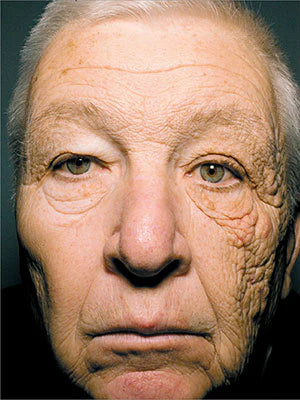
Twenty-eight years of a delivery route. The window glass filtered out most of the UVB — the burning wavelength — and let the UVA through, which is the one that goes deeper and quietly takes apart the collagen underneath.
He never burned. That’s the detail I can’t get past. Whatever happened to that side of his face happened without a single afternoon of pain to warn him.
Both sides of that man are the same age. Only one of them was exposed. Which means the difference you’re looking at isn’t aging at all — it’s a record of accumulated sun, drawn on a human face in the most literal way possible.

Much of what we associate with the natural aging process is actually sun damage. In fact, up to 90 percent of the visible changes commonly attributed to aging are caused by the sun.
The rest — genetics, time, everything else — is the small part.
Which is oddly good news. Because if most of it is caused by something specific, then most of it is something you can actually do something about.
03The mechanism
The sun doesn’t hit you. It starts a reaction.
This is the part that reframed the whole thing for me, and it’s worth ninety seconds.
A sunburn isn’t heat. You don’t burn from the sun the way you burn from a stove.
What’s happening is a chemical reaction: UV radiation lands in your skin, knocks electrons loose, and generates free radicals — unstable molecules tearing through your cell membranes looking for something to stabilize against.
That cascade is oxidative stress. It’s the same class of reaction as metal rusting or an apple browning. Just running inside living tissue.
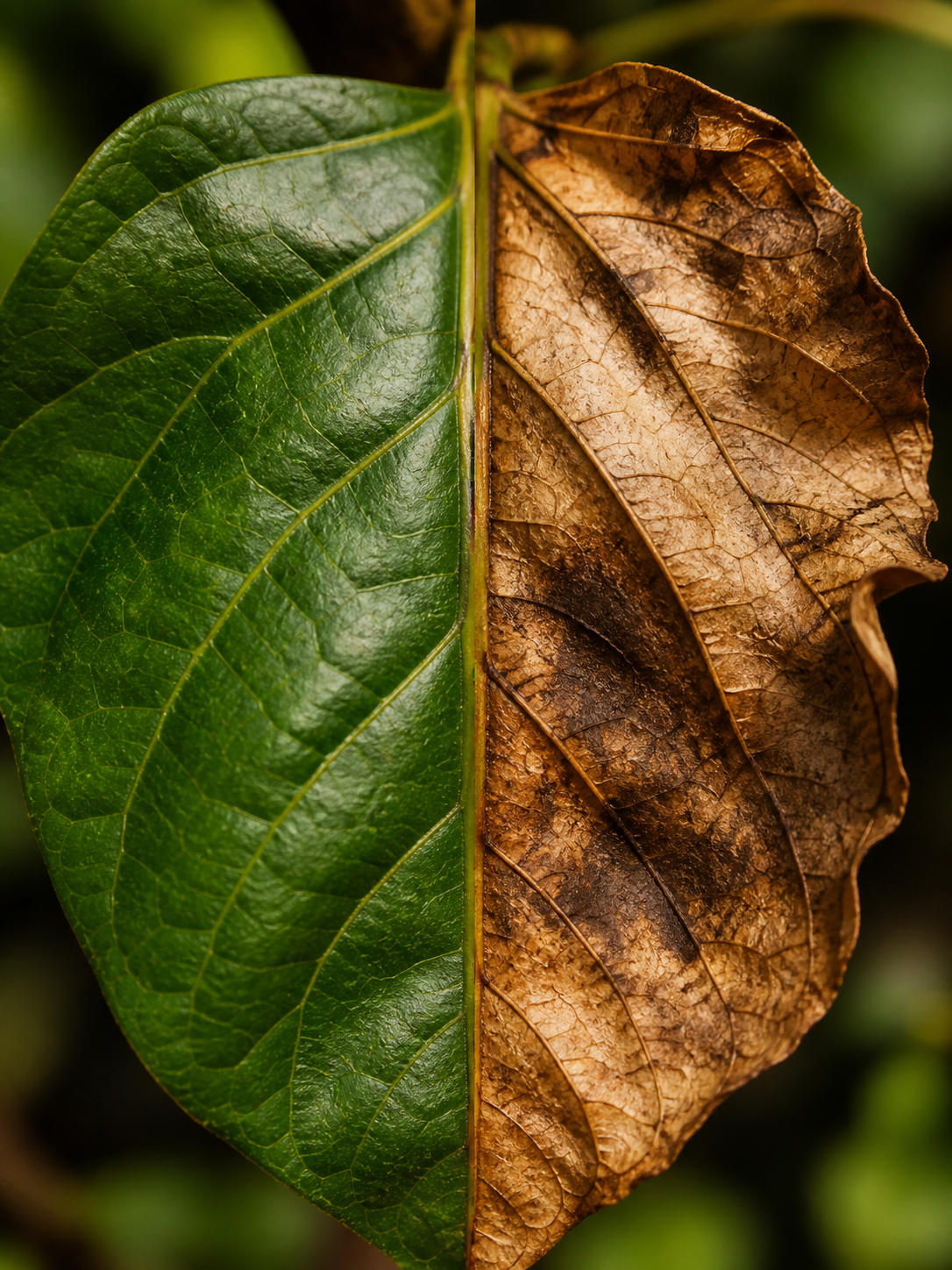
And it does two things you care about.
-
It damages the cells directly.
Membrane by membrane, as the free radicals tear through looking for something to grab onto.
-
It switches on MMP-1.
An enzyme whose entire job is breaking down collagen — activated by the reaction, not by the years.
That second one is the firmness leaving. Not the sun “drying you out.” An enzyme, switched on by the reaction, dismantling the scaffolding under your face.
So: sunscreen blocks the radiation. That’s what it does, and it does it well. It’s a shield standing between the sun and the reaction.
But a shield has a hard limit. It only works on what it catches.
- Nobody applies enough
- Nobody reapplies on time
- UVA goes straight through glass
- The overcast day you skipped it
And the second any of it gets past — the reaction starts, and the shield has nothing to say about it any more.
The gap
It’s not that sunscreen fails.
It’s that blocking and neutralizing are two completely different jobs — and almost everybody is only doing one of them.
04The organism
A single-celled algae ran into the same problem. It solved it the other way.
Haematococcus pluvialis lives in shallow freshwater. Rock pools, birdbaths, puddles.
When that water starts evaporating under direct sun, the cell is stuck in exactly the situation we’ve been describing: extreme UV, nowhere to hide, no shade to reach.
And here’s the thing — it can’t build a shield. A single cell has no capacity to manufacture something that sits between itself and the sun.
So it made something different.
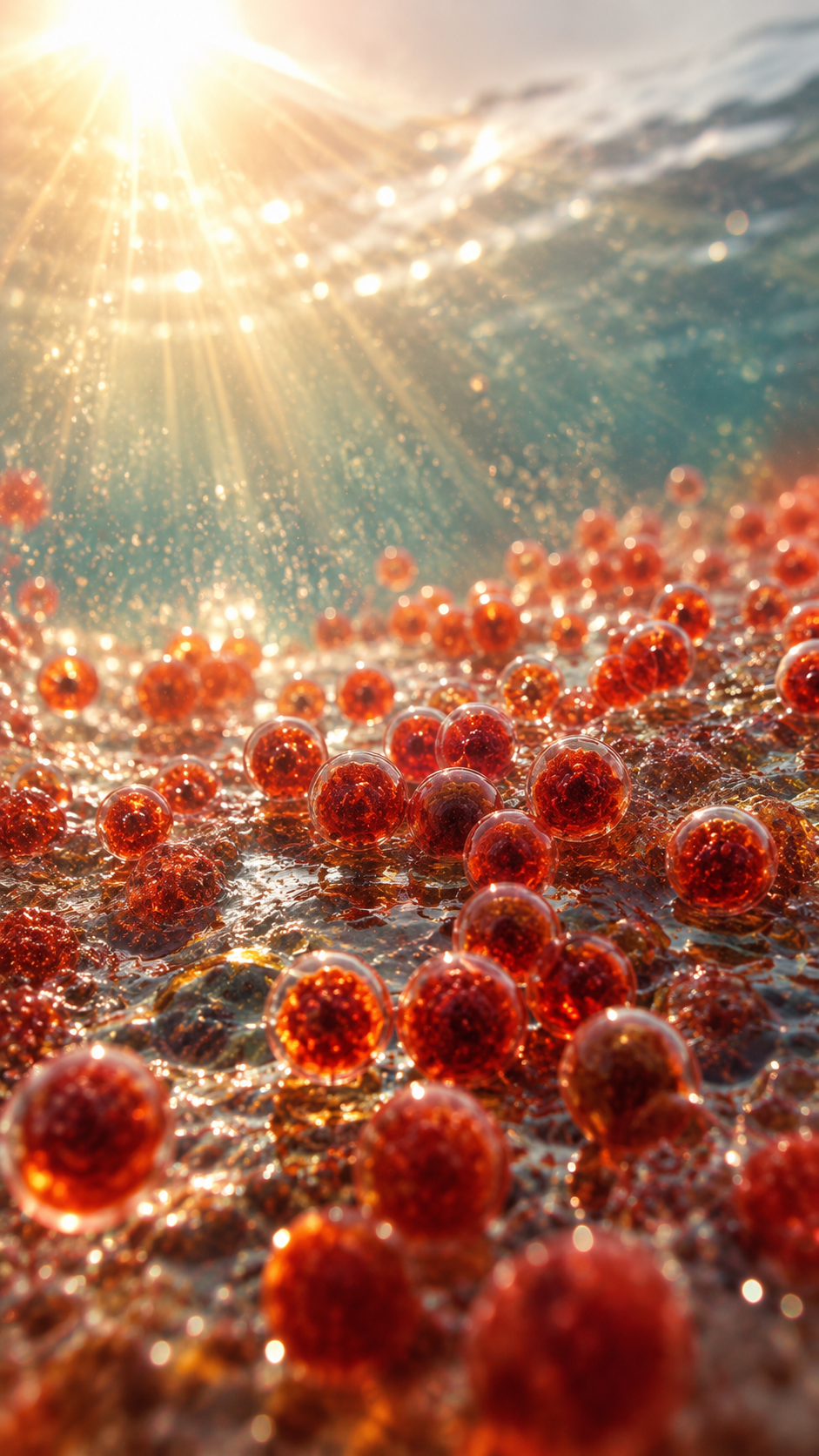
Sunscreen simply blocks most of the sun’s radiation from reacting on your skin.
Haematococcus pluvialis, in times of extreme stress — usually caused by extreme sunlight exposure — produces astaxanthin.
The algae cell can’t create something to block the sun’s harsh radiation like sunscreen. Instead it made something that can neutralize the chemical reaction the sun creates.
The distinction that matters
It may sound like not that big of a deal, but it’s a very important distinction.
The algae cell does not survive by hiding behind astaxanthin — it uses astaxanthin to reverse the oxidative damage the sun creates as it’s happening.
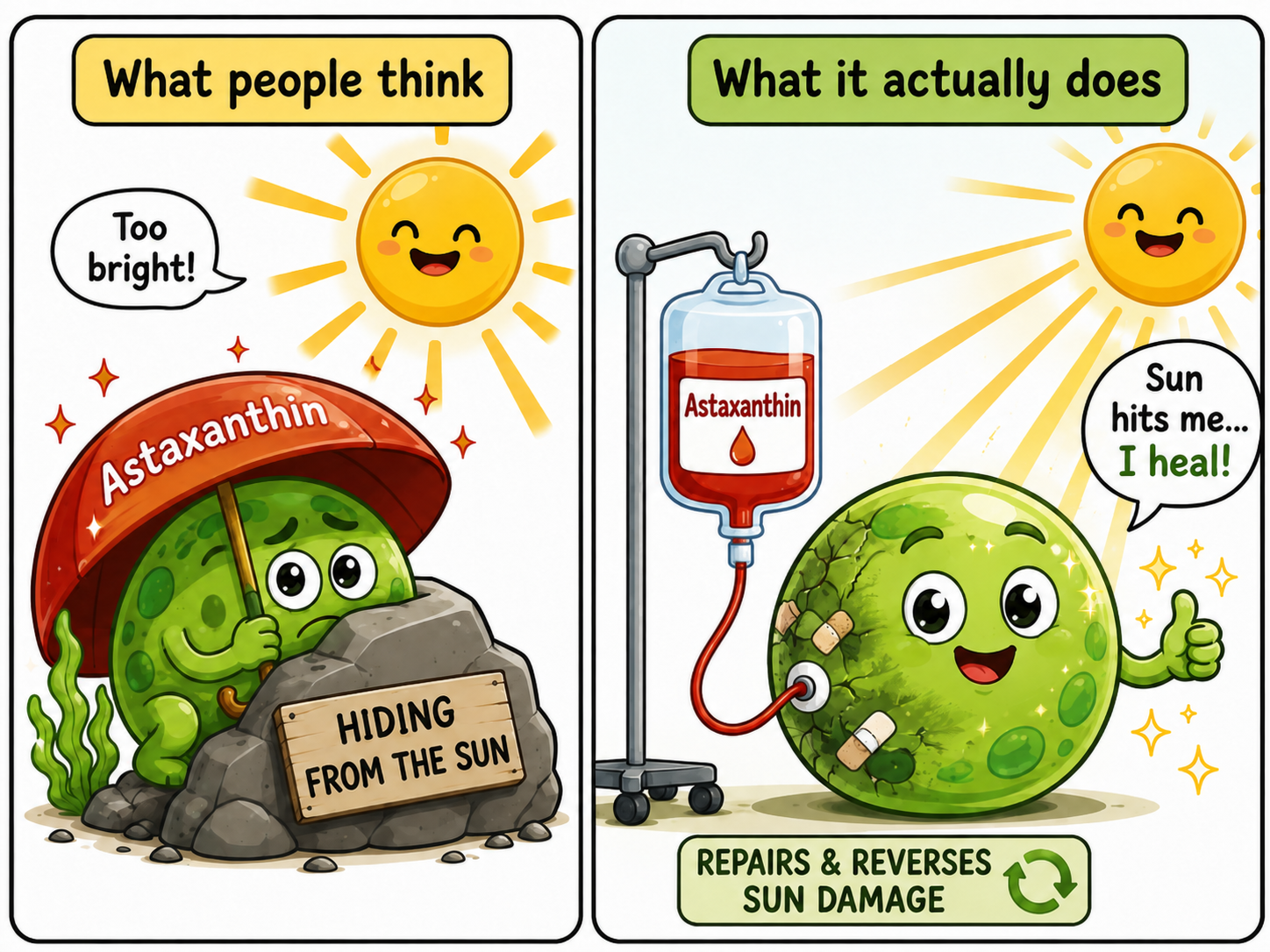
The radiation still gets in. The reaction still starts. Astaxanthin is sitting there neutralizing free radicals as fast as the sun generates them.
And it does that while spanning the entire cell membrane — covering the fatty outer layer and the watery interior at once. Most antioxidants only work in one of those two environments. This one is anchored across both.
- Vitamin C Water phase only
- Vitamin E Lipid phase only
- Astaxanthin Spans both — anchored across the membrane
And in human skin that translates straight back into the thing from three paragraphs ago: it suppresses MMP-1. The collagen-dismantling crew gets stood down.
That algae has been running this system for something like three billion years, under sunlight harsher than anything you’ll ever experience, with no other option available to it.
It’s not a trendy ingredient. It’s the oldest working answer to this exact problem that exists.
05The part nobody does
Two layers. Not one.
I want to be completely direct with you, because this is the part where a lot of brands would lie and I’m not going to.
Read this bit twice
This is not a sunscreen. It does not replace your sunscreen. Wear your sunscreen.
Sunscreen is the first layer and it’s non-negotiable. It stops most of the radiation before it ever reaches you.
What we’re talking about is the second layer — the one for everything the first one misses.
- The reapplication you didn’t do
- The drive home with the sun on your left arm
- The window seat
- The overcast day you didn’t bother
- The UVA that went straight through the glass
Sunscreen
Blocks.
Handles what hasn’t arrived yet.
Astaxanthin
Neutralizes.
Handles what already got in.
Almost everyone is doing the first and nothing about the second.
And the second is where every one of those four thousand Tuesdays quietly added up.
06The bottle
What we actually made.
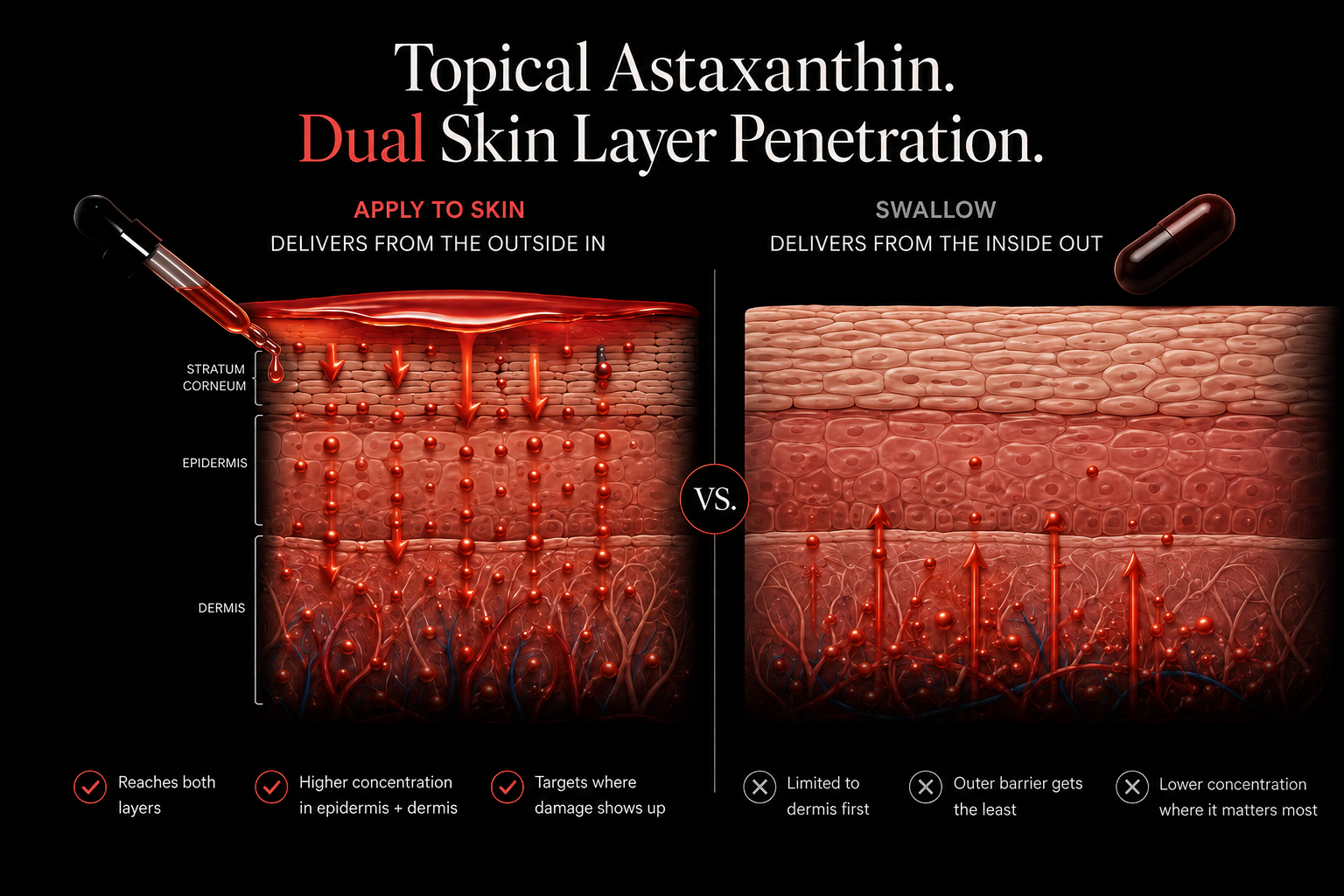
You can buy astaxanthin in a capsule. I want to explain why I didn’t build it that way, because the difference is the entire product.
-
It goes on, not down.
Swallow it and it travels through your gut, your liver, your bloodstream, and gets distributed everywhere your body decides it’s needed — your joints, your eyes, your muscles. Your face is at the end of a long line.
Applied topically, it starts where you actually want it.
-
The oil is the delivery system, not the filler.
This is the piece most people miss. A potent active is useless if it sits on the surface.
Our base is 70% squalane and 30% jojoba — that specific ratio because it’s molecularly near-identical to human sebum. Your skin doesn’t treat it as a foreign substance to be repelled. It recognizes it, and lets it through, carrying the astaxanthin down past the outer layer to where the collagen actually lives.
Which also answers the question you’re already asking: it doesn’t clog pores and it doesn’t sit greasy. It’s non-comedogenic and it absorbs — because your skin makes something almost exactly like it every day.
-
The highest strength we could stably formulate.
Not a token amount added to the ingredient list for the label. The whole thing is built around the active — and it’s 100% waterless, so there’s no water diluting the thing you’re paying for.
-
No ocean. No compromise.
Our algae is grown in sealed, closed-loop freshwater. Never harvested from the sea.
That’s deliberate: ocean-sourced marine ingredients carry the risk of heavy metals, microplastics and industrial runoff. This is a product you’re pressing into your face every single day. It shouldn’t come with a contamination question attached.
-
Nothing else in the bottle.
Zero synthetic preservatives. No parabens, no synthetic fragrance, no silicones, no mineral oil, no PEGs.
Rosemary extract and vitamin E do the preserving, and both earn their place — rosemary for microcirculation, vitamin E supporting the fade of existing sun spots and marks.
One note of honesty
Astaxanthin is a strong natural red pigment. That’s simply what it is. Let it absorb fully before your face hits a white pillowcase. I’d rather tell you now than have you find out.
07Me
Who’s actually writing this.
This is a real person writing, designing and formulating. I use these products every day myself.
I care a lot about my skin, and somewhere along the way I went properly down the rabbit hole on what the sun does to it. What I found was genuinely unsettling.
I can’t quite believe there was a stretch of my life where I’d spend whole days outside without a second thought — and looking back, nobody around me was talking about it either. Still mostly aren’t.
That’s really why this page exists. Not to scare you. Because the damage is quiet and slow and nobody flags it — and I think that’s exactly why it wins.
I also know how skincare goes. I’ve bought things that didn’t do what they said. So:
-
A 30-day money-back guarantee
And I mean regardless of how much of the bottle you’ve used. Use the whole thing. Email us inside 30 days, send it back — empty is completely fine — and you’re refunded.
-
A skin quiz I built myself
To match you to the right products instead of you guessing. If the Ruby Oil isn’t the one for you, it’ll tell you that.
-
The science is linked
Papers cited wherever I could find good ones. Read them. I’d rather you check than take my word.
Algae is about the most nutrient-dense thing on the planet — it’s the base of the entire food chain. It makes sense that with the right carrier and the right delivery, it does something serious for skin.
If you’ve read this far, thank you, honestly. Have a look at the products and the science behind them. And either way, I wish you well on your skin journey. Cheers.
— Brennan
Real skin. Real routines.
Don’t take our word for it. Take theirs.

I really wish I had started taking care of my skin sooner. I used to think it was kinda hopeless. But now I’m actually seeing some progress after all this time. My dermatologist told me I just needed to wash my face more and watch my diet, which never really seemed to work and cost me $500 for a 15-minute conversation. Now I’m giving my skin all of its nutrients topically, and really feeling great about where I’m going instead of accepting my fate lol.

Absolute holy grail! I treat my face and neck as one continuous canvas, so I always bring this face product down. It leaves my skin incredibly smooth, plump, and glowing. It absorbs beautifully without any sticky residue. Obsessed is an understatement!

This is absolute skin food! I’m so excited to finally find one moisturizer that delivers all the rich nutrients my face actually needs. My skin feels deeply fed, healthy, and completely hydrated without needing a ten-step routine. A total game-changer for simplified skincare!

Officially my unskippable daily staple! Getting all my skin’s vital nutrients in one quick step is a dream. My face feels incredibly nourished, smooth, and healthy every single day.
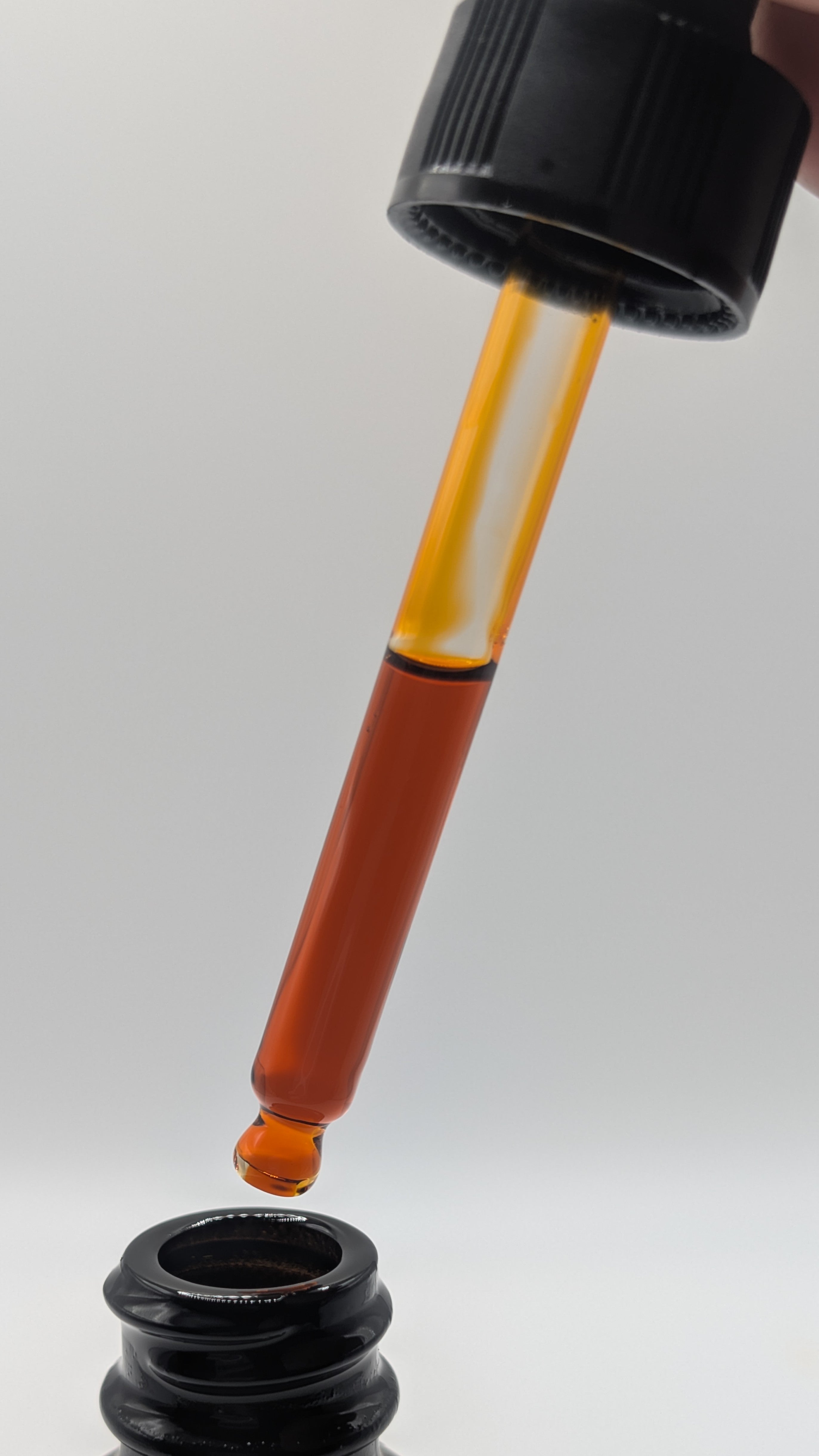
08The second layer
Ruby Cell-Defense Oil The second layer.
- 100% waterless
- High-strength astaxanthin
- 70/30 biomimetic base
- Closed-loop freshwater algae
- Zero synthetic preservatives
- Non-comedogenic
- Vegan
- Cruelty-free
- Small-batch
How to use
Cleanse. 3–5 drops warmed between the palms. Press into face and neck — press, don’t rub. Morning under your sunscreen, or evening. Both is better.
Save more
Subscribe and take 11% off your first order, 22% off every one after. Pause or cancel any time — and we email you 3 days before anything ships.
09Before you decide
The fair questions to ask me here.
Is this as proven as a vitamin C serum?
Vitamin C is well-studied and it works — in the water phase, at a low pH that a lot of people’s skin doesn’t tolerate.
Astaxanthin’s advantage is that it spans both the lipid and water layers of the cell membrane, and does it without acid, sting, or the low-pH irritation that makes people quit vitamin C in the first two weeks.
The one that actually works is the one you’ll keep using.
Will an oil break me out?
The base is 70% squalane / 30% jojoba — a near match for the oil your own skin produces. It’s non-comedogenic and it absorbs rather than sitting on top.
If your skin is currently reactive or broken, take the quiz; the Emerald line is built for that, and this isn’t the place to start.
Do I still need sunscreen?
Yes. Every day. This is the second layer, not a replacement for the first one.
Anyone telling you otherwise is selling you something they shouldn’t.
Can it undo damage I already have?
Here’s the honest answer. The strongest, best-supported thing astaxanthin does is neutralize oxidative damage as it’s happening and suppress the enzymes that break down collagen — that’s protection of what you still have, and it’s most of the value.
For existing sun spots and marks, vitamin E and the rosehip in the Ruby Salve support fading over time.
Anyone promising to erase twenty years off your face with a bottle of oil is lying to you.
Why not just take a capsule?
You can, and it’s not a bad idea for your body generally. It just isn’t a face product.
Oral astaxanthin gets distributed everywhere your body wants it; topical delivery in a sebum-identical carrier puts it where you’re actually asking for it.
Will it stain my skin?
No — it absorbs. Your linens are a different question. Give it a few minutes before bed.
The reaction is running either way. The only question is whether anything is standing in its way.
Sunscreen is the first layer, and you should wear it. This is the one for everything it misses — starting tonight.
Not sure which one is right for you? Start there.
30-day money-back guarantee — however much of the bottle you’ve used.