The Journal · The Molecule
The sun doesn’t reach you through your bloodstream. So why is the best defense against it sold as a pill?
Astaxanthin is the strongest antioxidant defense in nature — an algae builds it to survive full sun in a drying puddle. Nearly all of it is sold in capsules, which means your skin is last in line and gets the least. Put it on instead and it loads the surface first, then goes down. Here’s why that changes everything about what it can do.
01The ingredient
It’s rare that something stays this quiet. Astaxanthin managed it.
It’s pretty rare when something like astaxanthin can be under the radar for so long — especially since it has such sound science behind it, and especially when everyone is always ready to obsess over the next health ingredient.
An aside
Maybe you’ve already heard about it — but if you have, you most likely have heard of it as a dietary supplement.
02The route
Your skin is the last stop. Topical makes it the first.
While astaxanthin is becoming more popular, its greatest use for the skin is not from a dietary supplement, but from a direct topical application — as the skin is the final organ to gain nutrients from the gut.
Which, when you think about it, is rather obvious: your liver is probably more important to your body than your skin. People still argue about that one.
In any case, topical applications are not only faster, but can deliver a higher dosage to the target — in this case your skin — as the other organs are not competing for nutrients.
But it goes a step further. By applying astaxanthin topically, you get the dual skin layer penetration.
Think about the direction of delivery for a second, because it matters more than it sounds.
Swallow something and it arrives through your blood — which means it reaches your skin from underneath, seeping outward from the capillaries in the dermis. It fills from the inside out, and the outermost layers, the ones furthest from any blood supply, are the last to receive anything and get the least of it.
Now think about where the sun hits. The outside. The top. The exact layer that a blood-delivered antioxidant reaches last.
The sun doesn’t arrive through your bloodstream.
So why would you defend that way?
Topical goes the correct direction. It loads the front line first — the surface layers taking the direct hit — and then carries downward into the deeper tissue where your collagen actually sits.
You end up covered on the way in, not just at the destination.
03The molecule
Most antioxidants have to pick a side. Astaxanthin doesn’t.
That’s the first layer. Here’s the second, and this one is about the molecule itself.
Vitamin C is water-soluble, so it works in the watery interior of the cell and can’t enter the fatty membrane. Vitamin E is fat-soluble, so it sits in the membrane and can’t reach the water.
Every cell in your body has both environments, and free radicals are generated in both. Pick one antioxidant and you’re covering half the battlefield.
Astaxanthin doesn’t pick. Its structure is long, with polar ends and a fat-loving middle, so it threads straight through the cell membrane like a rivet — anchored in the water on both sides, spanning the fat in between. One molecule, sitting across both zones at once.
So a radical born in the membrane meets it. A radical born in the cell fluid meets the same molecule. There’s no gap for the reaction to slip through.
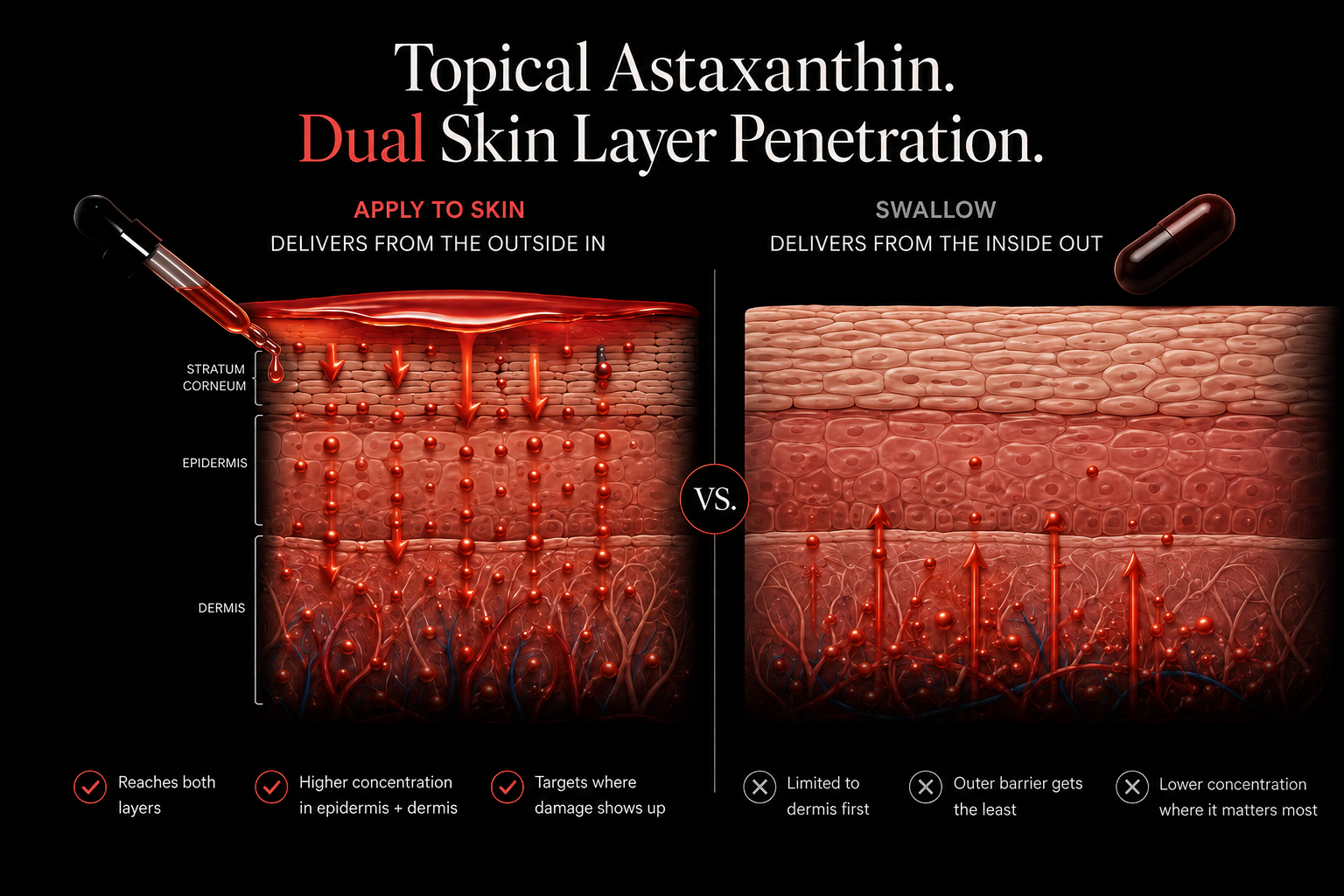
What “dual layer” actually means
Not two products.
One molecule doing two jobs that normally take two.
04The origin
Where it comes from. It only shows up when the cell is dying.
I want to tell you how this stuff is actually made, because once I understood it I couldn’t look at the bottle the same way.
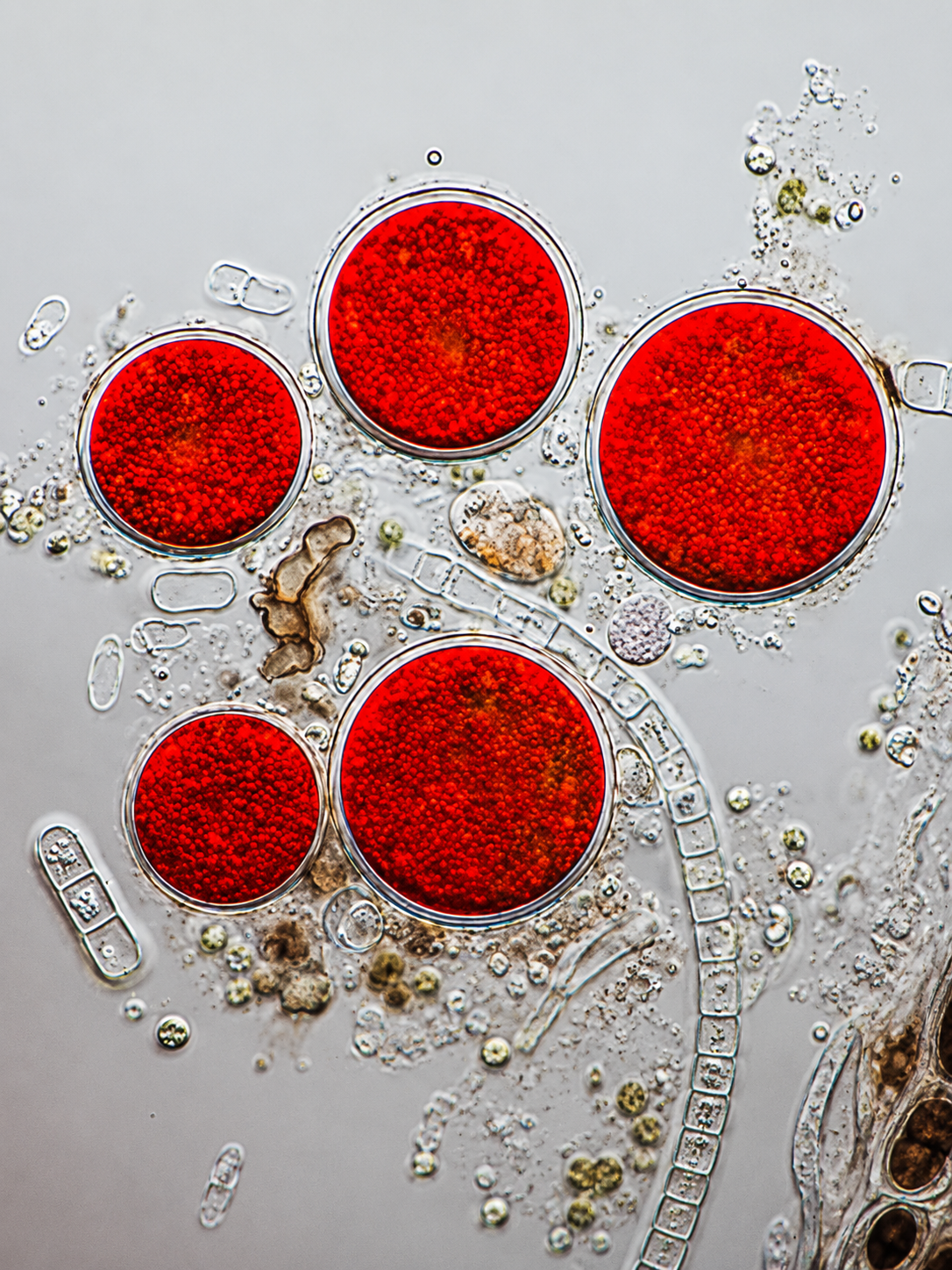
Haematococcus pluvialis spends most of its life green. It’s a small motile cell with two little whip-like tails, swimming around a rock pool or a birdbath, dividing, doing nothing remarkable. In that state it makes no astaxanthin at all.
The red only comes when the cell decides it’s about to die.
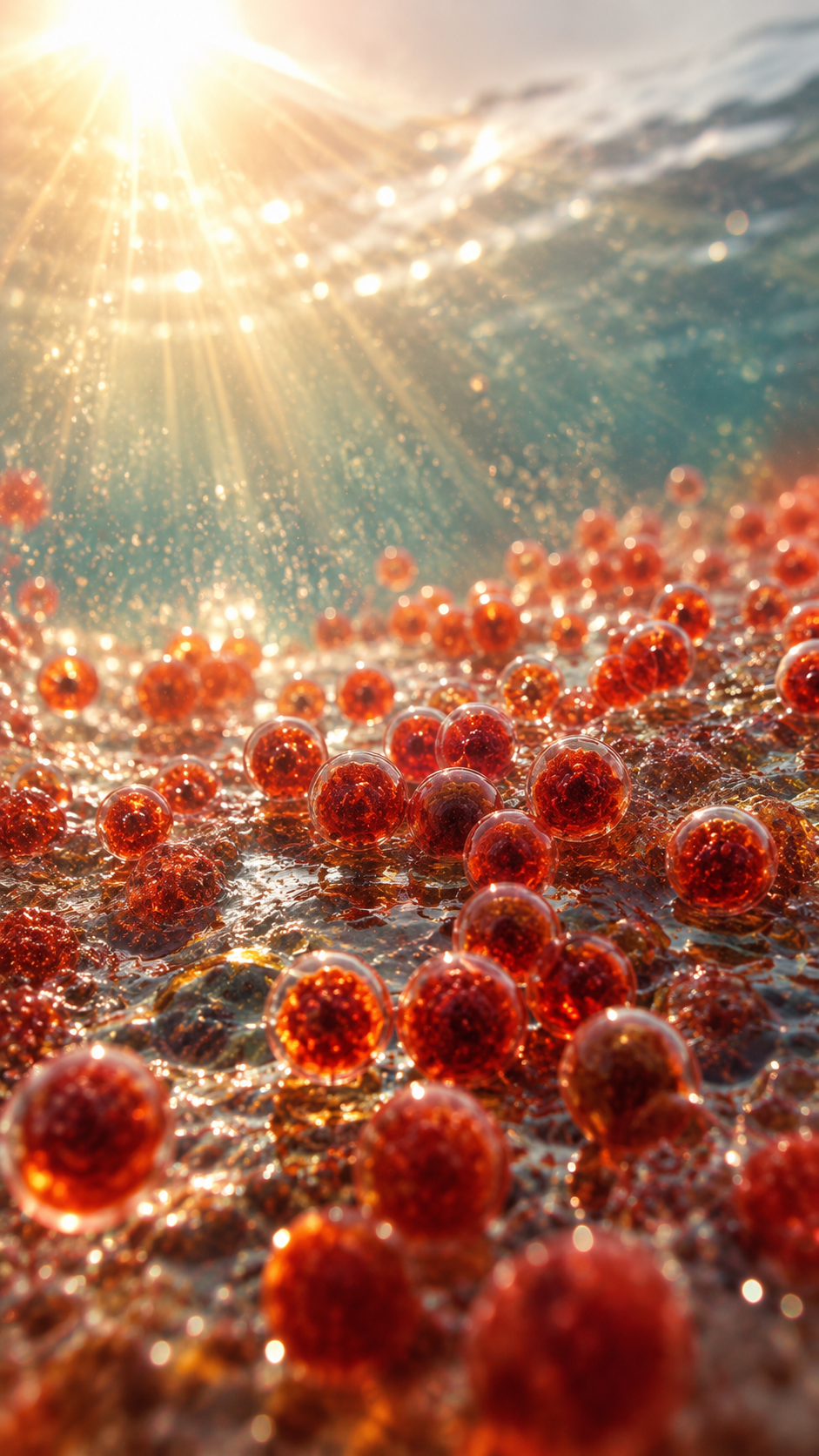
When the pool starts drying up — light going harsh, nutrients running out, water disappearing — the cell can’t swim away. There’s no deeper water to reach, no shade, nowhere to go.
So it does the only thing left. It drops its tails, seals itself inside a thick wall, and begins pouring everything it has into manufacturing astaxanthin. It floods itself so completely that the whole cell turns from green to deep blood red, and the pool turns red with it.
People have been finding red puddles and red birdbaths for centuries and wondering what happened.
That’s not decoration. That’s a cell spending its entire remaining energy budget on one molecule, because that molecule is the only thing standing between it and being taken apart by the sun.
And it works. Those red cysts can sit in a dried-out puddle, in full exposure, for years. Bake in it. Then rain comes, the water returns, and they come back to life green and swimming.
Some of the most extreme UV survival on the planet, and the entire strategy is one pigment.
05The cost
Which is why you can’t just harvest it.
Here’s the practical consequence, and it’s the reason good astaxanthin costs what it does.
You can’t go and collect this from somewhere. There’s no field of it.
The algae only makes astaxanthin under duress — so the only way to produce it is to grow the cells in their happy green phase, build up the biomass, and then deliberately put them through the exact conditions they built the defense against.
- Intense light
- Starvation
- Weeks of it
We don’t extract astaxanthin from the algae. We ask it for it. Under the only circumstances it will ever say yes.
Even then the yield is small — a few percent of the cell’s dry weight — and the wall it seals itself behind is genuinely tough, so it has to be cracked open properly or nothing gets released at all.
It’s one of the more expensive natural pigments in the world for exactly these reasons. Every step of it is slow and none of it can be rushed.
Where ours comes from
Grown in sealed, closed-loop freshwater. Never the ocean, never harvested wild.
Partly that’s control — you can only stress a culture on purpose if you own every variable in the tank.
But mostly it’s what’s not in it: no heavy metals, no microplastics, no industrial runoff, none of the things that come with anything pulled out of open seawater.
This is going on your face daily. It shouldn’t arrive with an unknown attached.
06The bottle
And then it’s yours.
So here’s what’s actually in the bottle.
A single cell, with no shield available to it and nowhere to hide, put everything it had into building a molecule that could stand in front of the sun’s chemistry and cancel it. It’s been refining that answer for something like three billion years, under light far harder than anything you’ll ever stand in.
We didn’t invent that. We just found the thing that already solved it, asked it to make its defense, and figured out how to carry it into skin.
You press three drops into your face in the morning. That’s it — that’s the whole ask. And the thing going in is the same emergency defense the algae builds when it has nothing else left.
It just doesn’t have to be an emergency for you. You get it as a habit.
07The whole story
So that’s the whole story.
That’s the whole thing I wanted to tell you.
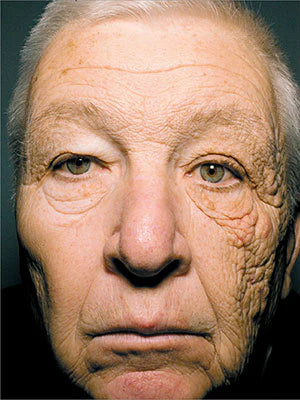
The sun is doing more to your face than almost anything else, and it’s doing it quietly enough that you’ll only notice in a photograph, years late. Sunscreen catches most of it. Something always gets past. And what gets past isn’t a mark on your skin — it’s a reaction running inside it, taking apart the collagen underneath.
There’s a molecule that steps into that reaction and stops it. An algae built it out of desperation, and it turns out it works just as well when it’s not desperate. Put it on and it goes the right direction — front line first, deeper after — and it covers both halves of every cell it reaches.
I didn’t figure any of this out. I just went looking, found it, and couldn’t understand why nobody was talking about it.
I use it every morning. Three drops, warmed, pressed in, then sunscreen over the top. Twenty seconds. It’s not a new routine, it’s one more layer on a step you’re already doing.
That’s genuinely all I’m asking you to try.
Thanks for reading this far — I know it was long, and I know most people won’t have. If it’s the right thing for you, it’s below. If you’re not sure it is, take the quiz and it’ll tell you honestly, even if the answer is something else.
Either way I hope you’re kinder to your skin than I was to mine for a while there.
Cheers,
— Brennan
Real skin. Real routines.
Don’t take our word for it. Take theirs.

I really wish I had started taking care of my skin sooner. I used to think it was kinda hopeless. But now I’m actually seeing some progress after all this time. My dermatologist told me I just needed to wash my face more and watch my diet, which never really seemed to work and cost me $500 for a 15-minute conversation. Now I’m giving my skin all of its nutrients topically, and really feeling great about where I’m going instead of accepting my fate lol.

Absolute holy grail! I treat my face and neck as one continuous canvas, so I always bring this face product down. It leaves my skin incredibly smooth, plump, and glowing. It absorbs beautifully without any sticky residue. Obsessed is an understatement!

This is absolute skin food! I’m so excited to finally find one moisturizer that delivers all the rich nutrients my face actually needs. My skin feels deeply fed, healthy, and completely hydrated without needing a ten-step routine. A total game-changer for simplified skincare!

Officially my unskippable daily staple! Getting all my skin’s vital nutrients in one quick step is a dream. My face feels incredibly nourished, smooth, and healthy every single day.
The Algae Aura Promise
Every bottle arrives risk-free.
-
30 Days, Free
Money-Back Guarantee
Wear it, sleep in it, judge it in your own mirror. If your skin isn’t calmer, softer, and brighter within 30 days, we refund you in full — single bottles and bundles alike.
-
2–7 Days
Fast U.S. Shipping
Packed and dispatched from the United States, tracked from the moment it leaves the warehouse. No overseas wait for it to reach you.
-
$5 Flat
Shipping, Capped
One rate on every order — a single bottle or the whole ritual, the number never climbs. Past $65 it drops to zero on its own.
-
22% Off
Every Bundle
Build the full ritual and the whole set comes in 22% under the price of the same pieces bought alone.
-
Loyalty Pricing
Subscribe & Save More
Start a subscription and unlock a loyalty discount that carries into every future order. Cancel any time.
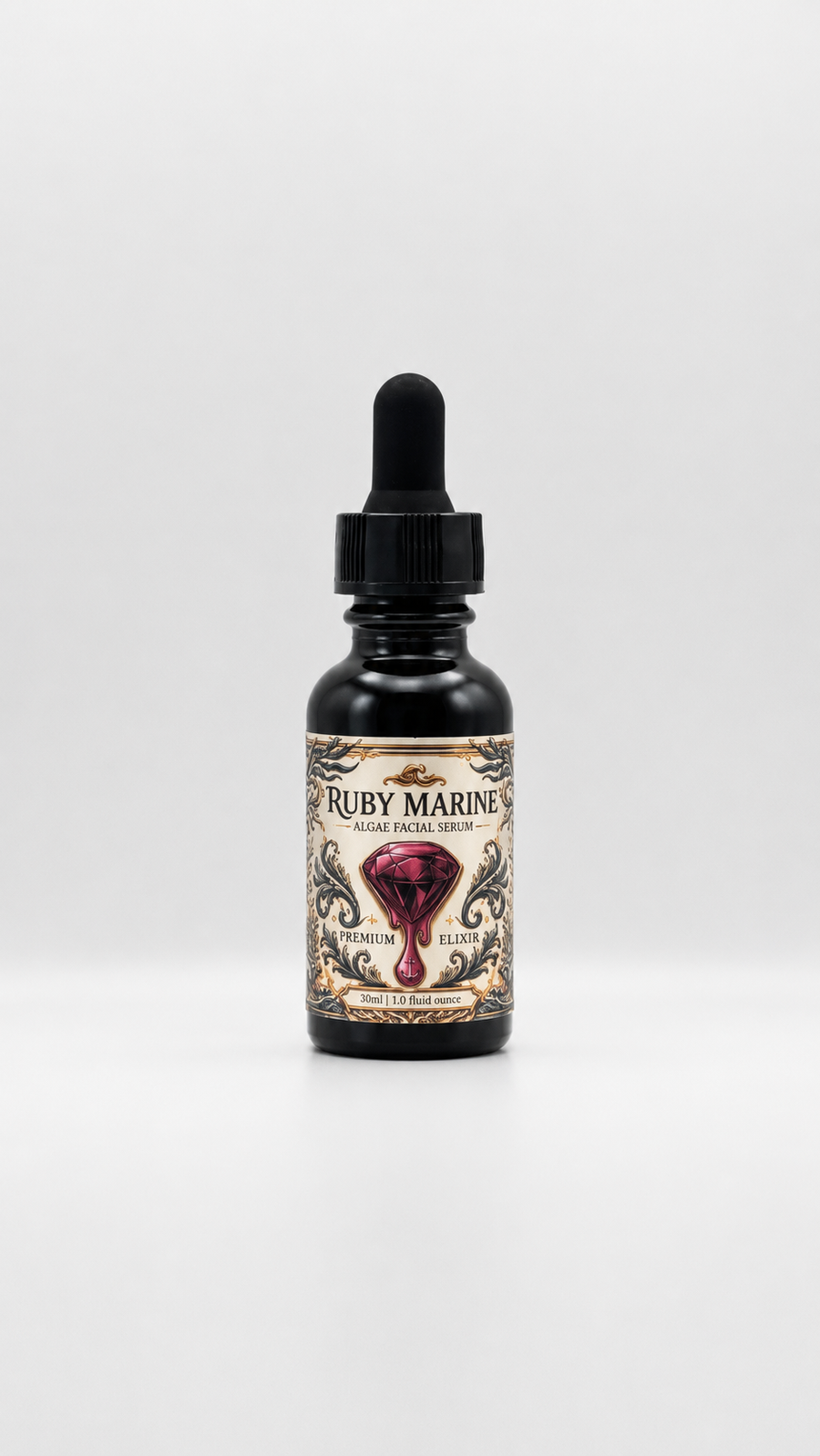
Astaxanthin Facial Oil
A biomimicking oil base that carries microalgae-derived astaxanthin straight into your skin barrier. The topical route, at the strength we could stably formulate.
View Product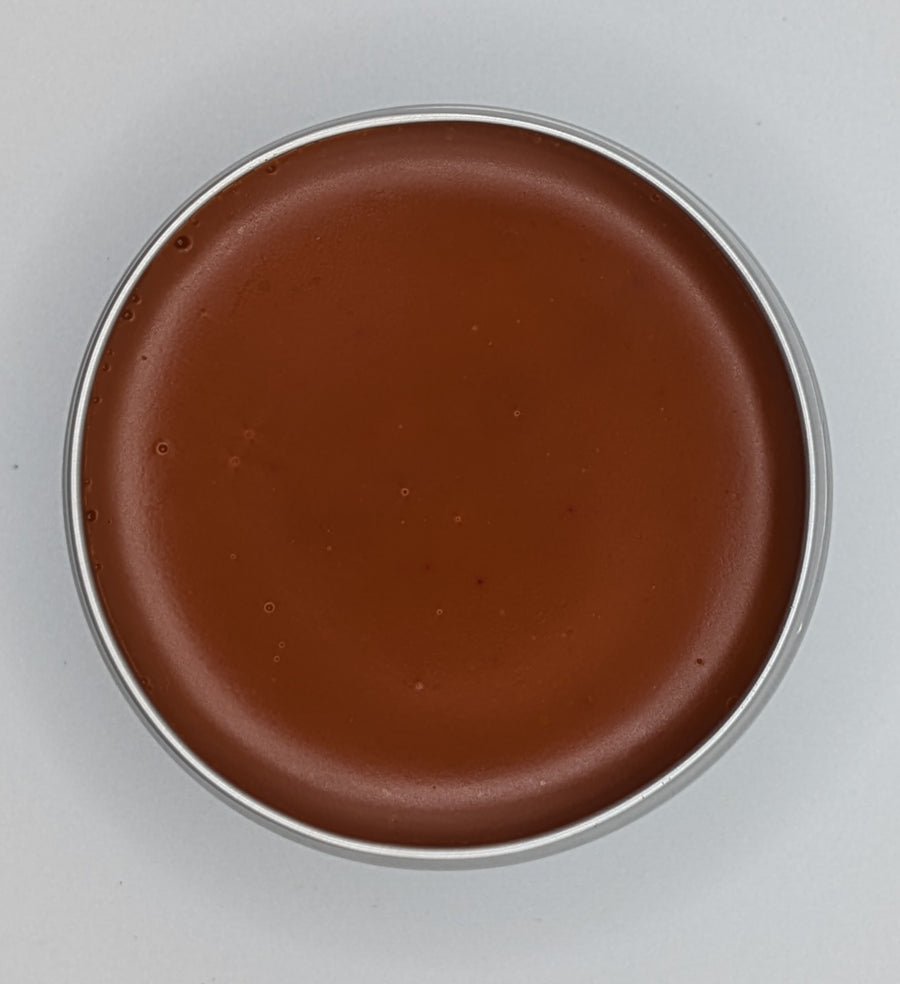
Astaxanthin Salve
The same astaxanthin under a breathable beeswax seal, with cold-pressed rosehip. Day defends, night rebuilds.
View Product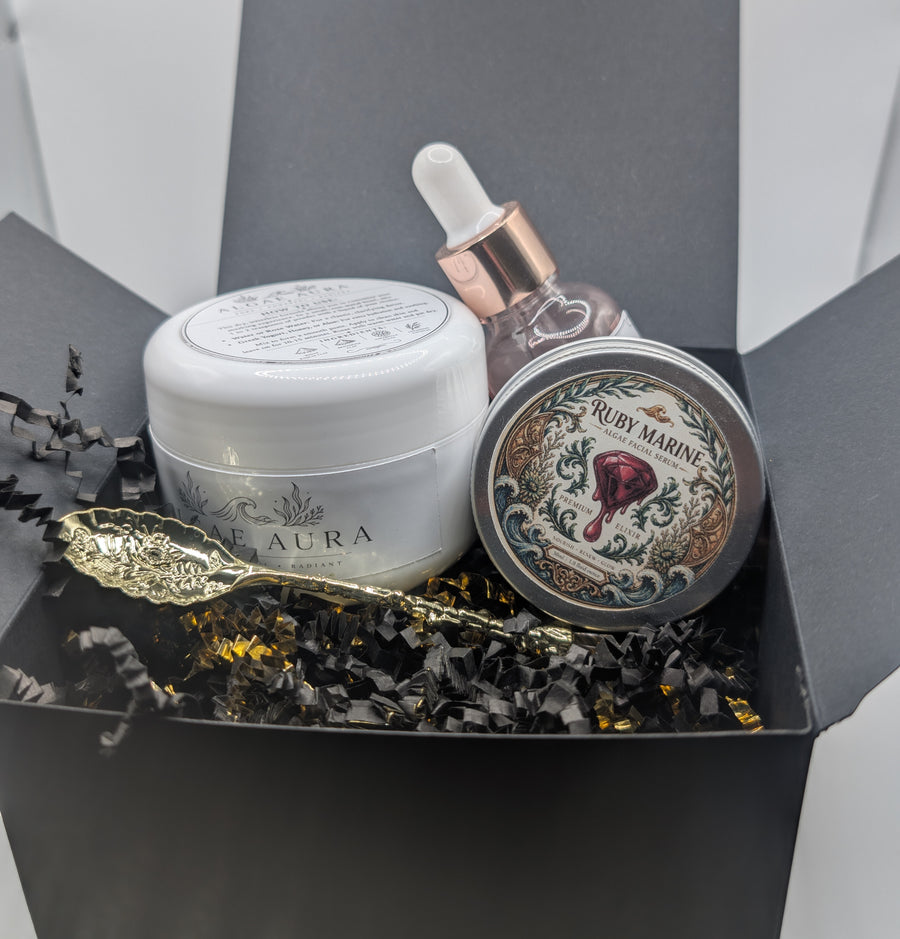
Build the Full Ritual
Mask, exfoliator and your choice of oil or salve — the whole set at 22% under the price of the same pieces bought alone.
Build Your Ritual