For anyone in their 20s who thinks they have time
I wish I knew this when I was 27.
I thought aging was about making less collagen. It mostly isn’t. It’s about what happens to the collagen you already have, every time you step outside.
Drawn from research in the New England Journal of Medicine · sources
First, how old are you?
It only tailors what you read next.
01A quick guess
How much of the aging you’ll see is the sun’s doing?
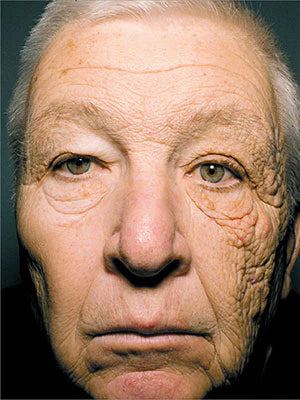
Not burns. Just ordinary days: the walk to the car, the window seat, the weekend outside.
Most people guess under half. Researchers put it at up to 80%.2
Close. Researchers put it at up to 80%.2
You’re ahead of most people: researchers put it at up to 80%.2 You already know the sun matters. Almost nobody knows how.
Lines, slackness, uneven tone. The bulk of what we call “getting older” is accumulated daylight, not birthdays.
In short: up to 80% of visible aging is daylight, not age.
But you’re not burning. So what is it actually doing?
02The number everyone’s scared of
Your collagen peaks around 30. Then it slips about 1% a year.
That line sells a lot of serums to people in their twenties. Here’s what it actually looks like.1
By 40, that’s roughly 10% less. Real, but gradual. Nothing about it makes anyone look “suddenly” older.
What makes skin look older
The daylight part is the part you can actually do something about.
So if you’ve been quietly worried about your collagen, here’s the good news: the slow part isn’t the part that shows. You’re still building toward your peak. Protect it, and it lasts.
So if you’ve been quietly worried about your collagen: at 1% a year, you’ve lost far less than you think. And the slow part isn’t the part that shows.
At 27, I spent my money trying to make more collagen. It’s like bailing water with a bucket while someone keeps drilling holes in the boat.
In short: collagen falls about 1% a year after 30. Slow. The fast part is damage.
So where do the holes come from?
03What daylight actually does
Your skin treats daylight like a tiny injury.
You knew the sun matters. Here’s the how.
No sunburn. No pain. But underneath, daylight sets off a chain reaction: sparks (free radicals) switch on scissors (enzymes that cut collagen).3
Your skin does what it does with any injury: clears the damage and rebuilds, fast. Fast isn’t neat. Researchers call the result a solar scar: invisible on its own, and very visible after thousands of them.
At your age, you’ve already lived through a lot of summers. Some of what shows at 40 has started. The good news: most of it hasn’t.
In short: daylight damages collagen a little every day, and skin patches it imperfectly.
So why doesn’t skin just fix it properly the next time?
04Why it seems to happen all at once
Skin rebuilds from what’s there. A copy of a copy.
You’re around copy 5.
Skin is always rebuilding, and it rebuilds from the template it has. When that template is already a little damaged, the new copy inherits the damage, and adds its own.
Researchers have even found that broken collagen pieces send signals of their own that slow fresh collagen down.4,5 That’s why it seems to happen “all at once” in your mid-30s. It didn’t. It was compounding since your 20s.
At your age the copies are still sharp. That’s exactly why this is the time.
Past 30 isn’t too late. Every copy you protect is a better template for the next one.
In short: damage compounds, because skin rebuilds from damaged templates.
So how do you break the cycle?
05Your move
Where would you break the loop?
More bricks, same wrecking crew. Retinol and vitamin C are good at rebuilding, which is why they’re repair tools. At 27 there’s little to repair, and they’re the ones most likely to sting, flake or redden.
Yes. Always. Sunscreen is the first layer and nothing replaces it. But no sunscreen stops all of it, and every bit that gets through starts a spark.
The one most routines skip. Every turn of the loop starts with a spark, and antioxidants are how skin puts sparks out.
The answer isn’t one or the other. It’s block the light and put out the sparks, every day: sunscreen on top, an antioxidant underneath.
That’s what I got wrong at 27. I was trying to build more, when I should have been protecting what I had.
In short: sunscreen on top, an antioxidant underneath, every day.
Here’s the catch: most antioxidants only cover half of a skin cell. There’s one that covers both halves. You’ve almost certainly eaten it.
06The answer
Astaxanthin. The pigment that makes salmon pink.
A freshwater microalga makes it to survive light that should kill it. It’s a deep-red antioxidant, and its shape is what makes it different.
Tap each one to see where it works. Vitamin C works in the watery parts of the cell. Vitamin E works in the oily wall. Astaxanthin is long enough to reach across the oily wall and touch the water on both sides. Both halves, one molecule.6
- No acid. It works at a neutral pH, so there’s nothing in it to sting.
- Lives in oil. It’s fat-soluble, so it belongs in an oil, not a watery serum.
- 0 ocean contaminants. Ours is grown in sealed freshwater tanks and never touches the ocean.
In short: astaxanthin is an antioxidant that covers both halves of a skin cell, with no sting.
 That’s what’s in Ruby. Astaxanthin in a waterless squalane and jojoba base, made for mornings under your sunscreen.Get your protocol
Bonus round
You’re the antioxidant. Tap the sparks before they reach the collagen.
07Your protocol
Two quick taps, and here’s your routine.
How does your skin feel by midday?
Do strong actives (vitamin C, retinol, acids) ever sting or redden your skin?
Do you use retinol, or plan to?
Your Ruby Protocol
- Morning
Ruby oil: three drops, warmed and pressed in after cleansing. Then your sunscreen on top.
- Night
Emerald oil: three drops as the last step before bed. On retinol nights, retinol first, let it settle, then Emerald.
Nothing in Ruby is there to sting: no acid, no alcohol, no synthetic fragrance. Patch-test on your jaw first anyway.
So here’s what I wish I’d known at 27: you can’t stop time, but you can stop leaving your skin unprotected. Three drops of Ruby every morning, under your sunscreen.
30-day money-back guarantee: ship it back, even empty, and we refund you in full.
Fair warning: it’s red. Real astaxanthin is a strong pigment, so let it sink in before it meets a white pillowcase. That colour is the astaxanthin itself.
Want the full routine with a weekly mask? See the Complete Algal Ritual →Still deciding?
Fair questions, straight answers.
Isn’t retinol the gold standard?
For rebuilding, it’s one of the best-studied ingredients there is. You don’t have to choose: plenty of people use retinol at night and Ruby in the morning. If you use prescription skincare, check with your dermatologist first.
Do I still need sunscreen?
Yes, every day. Ruby isn’t a sunscreen and has no SPF. Sunscreen is the outer layer; Ruby is the antioxidant layer underneath it.
Why not a vitamin C serum?
Vitamin C is a good ingredient. It’s just not the gentlest daily start at 27.
Oils break me out.
Ruby’s base is squalane and jojoba, close to your skin’s own oils, so it sinks in rather than sitting on top. Both are considered non-comedogenic. No silicones, no mineral oil.
Can’t I just take astaxanthin pills?
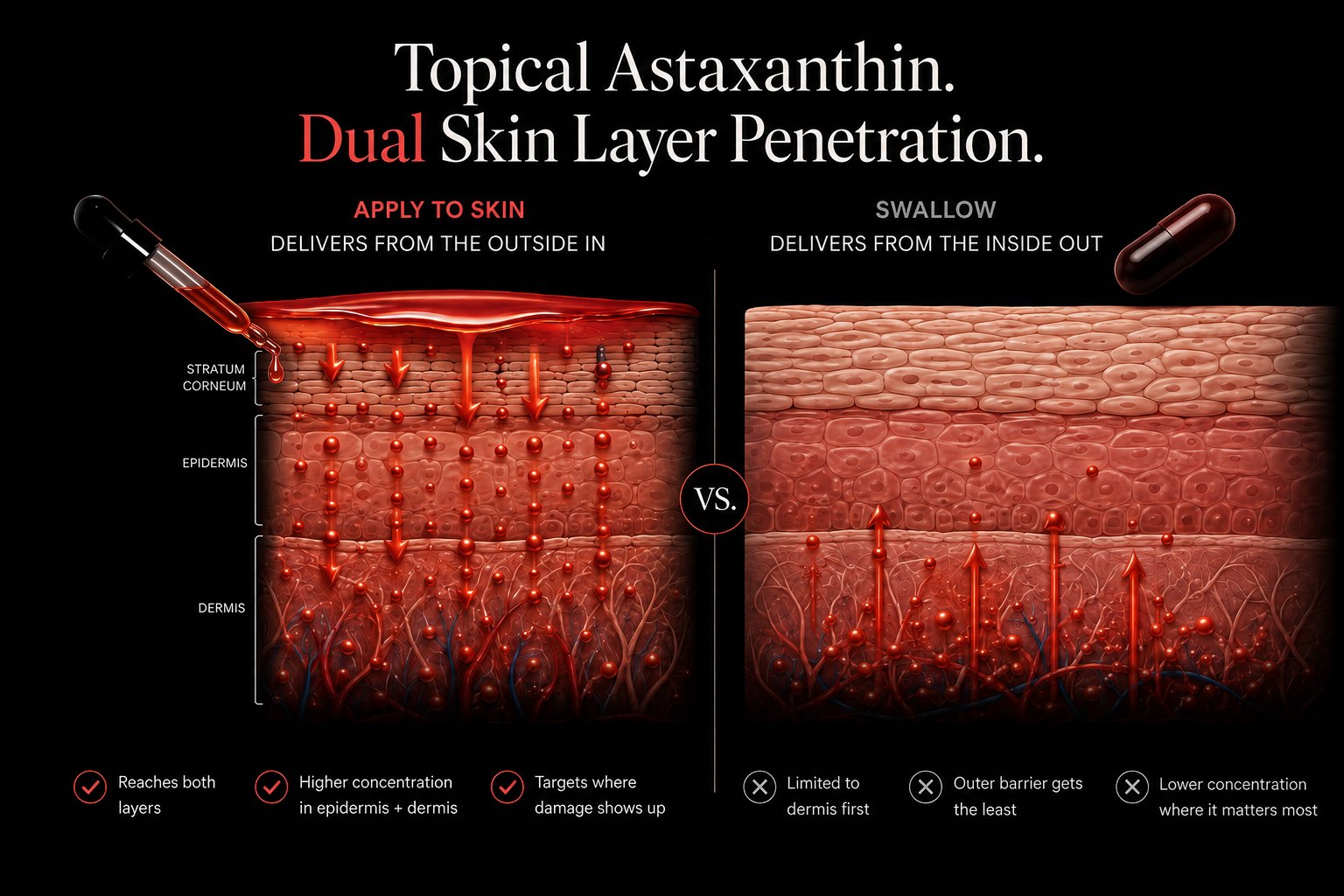
You can, and plenty of people do. Swallowed, it’s shared out across your whole body. Pressed in, it starts where you put it. Many people do both.
Is the algae clean?
Yes, and this is the part most people never ask about. Algae harvested from the sea soaks up what’s in the water: heavy metals, microplastics, runoff. Ours is grown in sealed freshwater tanks and never touches the ocean, so it carries zero ocean contaminants. Every batch is then mixed by hand in small runs.
Is it worth the money?
Together with Emerald, 22% comes off automatically. And if it isn’t for you, ship it back, even empty, for a full refund.
In their words
Our growing algae enthusiasts.
-

I used to think it was kinda hopeless. But now I’m actually seeing some progress after all this time.
-

It leaves my skin incredibly smooth, plump, and glowing. It absorbs beautifully without any sticky residue.
-

My skin feels deeply fed, healthy, and completely hydrated without needing a ten-step routine.
-
Officially my unskippable daily staple! My face feels incredibly nourished, smooth, and healthy every single day.


The science behind this page6 sources
These describe skin biology and ingredient research. They are not studies of Ruby, and nothing here is a promise about what a cosmetic does.
- Shuster S, Black MM, McVitie E. The influence of age and sex on skin thickness, skin collagen and density. British Journal of Dermatology, 1975.
- Flament F, et al. Effect of the sun on visible clinical signs of aging in Caucasian skin. Clinical, Cosmetic and Investigational Dermatology, 2013.
- Fisher GJ, et al. Pathophysiology of premature skin aging induced by ultraviolet light. New England Journal of Medicine, 1997.
- Fisher GJ, et al. Collagen fragmentation promotes oxidative stress and elevates matrix metalloproteinase-1 in fibroblasts in aged human skin. American Journal of Pathology, 2009.
- Varani J, et al. Decreased collagen production in chronologically aged skin. American Journal of Pathology, 2006.
- McNulty HP, et al. Differential effects of carotenoids on lipid peroxidation due to membrane interactions: X-ray diffraction analysis. Biochimica et Biophysica Acta, 2007.
Your protocol is saved
The best time was 27. The next best time is today.
Start my Ruby ProtocolThanks for reading this far.
— Brennan
How do I use it?
Mornings, after cleansing: warm three to five drops between your palms and press them in. Let it sink in for a minute, then your sunscreen.
Will it stain?
It can, before it absorbs. The red is real astaxanthin, not a dye, so give it a few minutes before white towels or pillowcases.
I’m pregnant or breastfeeding. Can I use it?
Please ask your doctor before starting any new skincare.
How fast does it ship?
Orders arrive in 2–7 business days in the US. Shipping is free over $65.

Your Ruby Protocol
$71.76 · 30-day guarantee